 ichael Ouroumis
Closures Explained Visually
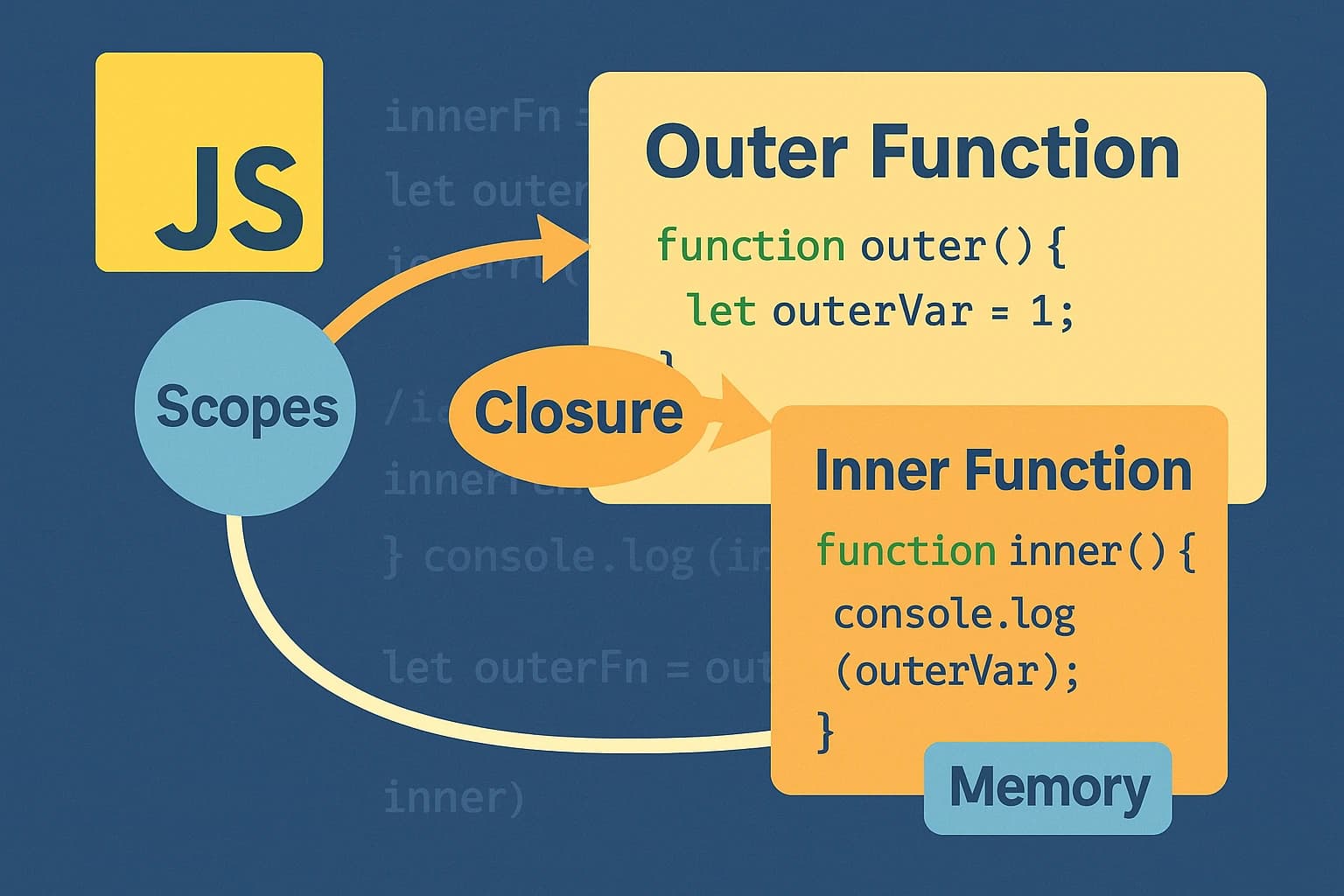
TL;DR:
A closure is when an inner function retains access to variables from its outer (lexical) scope even after that outer function has returned. Closures power callbacks, module patterns, data privacy, and more—once you visualize the scope chain, they become easy to grasp.
What Is a Closure?
A closure happens whenever you define a function inside another function. The inner function “closes over” its surrounding state (variables, parameters, and other functions) and keeps a reference to it, even if that outer function has already finished executing.
Analogy: Think of the outer function’s variables as objects in a box, and the inner function as a note that carries the key to open that box anytime.
1. Simple Closure Example
function makeCounter() {
  let count = 0 // Outer scope variable

  return function () {
    // Inner function closes over `count`
    count += 1
    console.log(count)
  }
}

const counter = makeCounter()
counter() // → 1
counter() // → 2
counter() // → 3
makeCounterreturns an inner function that referencescount.- Even after
makeCounterreturns,countlives on in the closure. - Each call updates the same
countin memory.
2. Visualizing the Scope Chain
- Invocation: Call
makeCounter(). JS creates an execution context with a localcount = 0. - Return: JS hands back the inner function, but the local scope stays alive as part of that function’s closure.
- Calls: Each time you invoke the returned function, it looks up
countin its own closure, updates it, and logs the new value.
[ makeCounter scope ] ──► { count: 0 }
         ↓ returns
[ counter() closure ] ──► remembers { count: 0 } and updates it
3. Common Use Cases
- Data Privacy / Encapsulation: Hide variables from the global scope.
- Partial Application: Pre-fill a function’s arguments.
- Factory Functions & Module Patterns: Bundle stateful behavior.
- Event Handlers & Callbacks: Preserve context across async calls.
function greeter(name) {
  return function (msg) {
    console.log(`${name}, ${msg}`)
  }
}

const hiAlice = greeter('Alice')
hiAlice('welcome!') // → "Alice, welcome!"
hiAlice('how are you?') // → "Alice, how are you?"
4. Pitfalls & Best Practices
| Pitfall | Why It Matters | Tip |
|---|---|---|
| Unintended Memory Leaks | Closed-over variables never get garbage-collected | Break references when no longer needed |
| Loop & Closure Gotchas | All closures capture the same binding | Use let (block scope) or IIFE per iteration |
| Over-nested Functions | Hard to read and debug | Flatten where possible; name your inner funcs |
Loop Example Fix:
// ❌ All callbacks share i===5
for (var i = 0; i < 5; i++) {
  setTimeout(() => console.log(i), 100)
}

// ✅ Each callback gets its own `i`
for (let j = 0; j < 5; j++) {
  setTimeout(() => console.log(j), 100)
}
5. When and Why to Use Closures
- Keep state between calls without globals.
- Build factories that generate tailored functions.
- Implement modules that expose a public API while hiding internals.
Closures are a cornerstone of JavaScript’s expressive power—once you see the scope chain in action, you’ll spot opportunities to write cleaner, more modular code.